5 Signs It's Time to Get Help for Binge Eating (Even If You Think You're Not "Bad Enough")
October 15, 2026
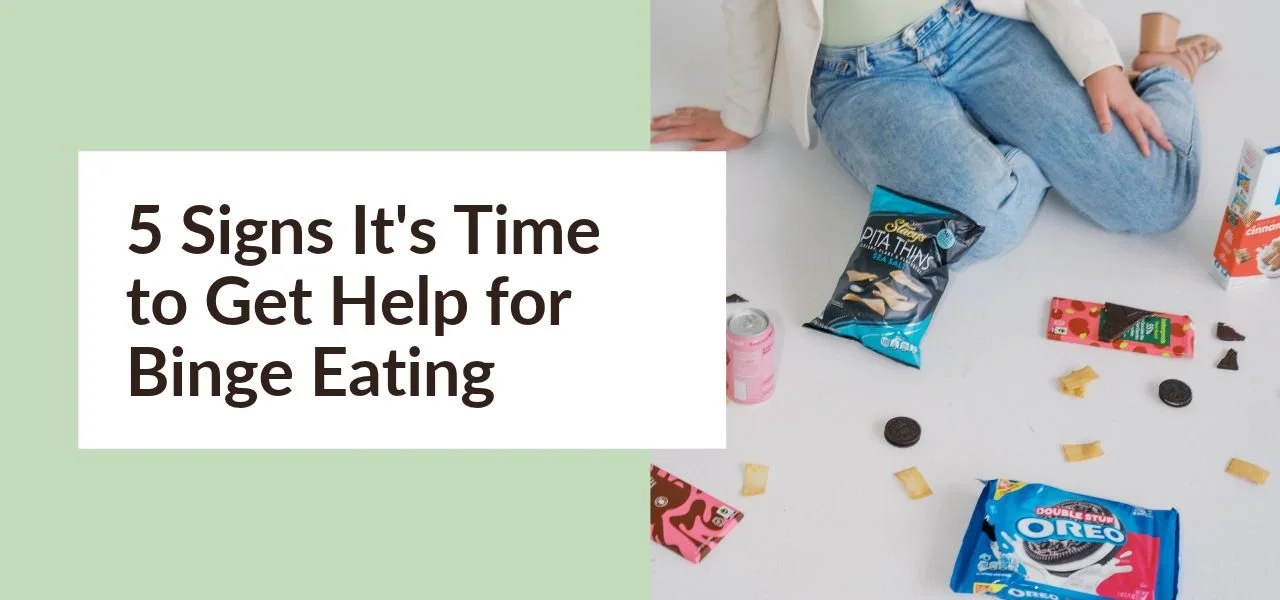
Have you ever thought to yourself, "Maybe my eating habits aren't THAT bad. Do I really need to get help with this? Maybe I can just try this on my own.
Somebody out there has it way worse than me, and I'll just be better once Monday comes around. I'll make a new plan and start over again."
I hear some version of this all the time and it’s one of the biggest reasons that I see good, smart, capable people stay stuck binge eating for years.
So today, I'm gonna walk you through the 5 signs that it's time to get help. By the end of this episode, you'll know exactly where you stand, and I think a couple of these are going to surprise you.
Have you ever thought to yourself, “Maybe my eating habits aren’t that bad. Do I really need to get help with this? Maybe I can just try this on my own. Somebody out there has it way worse than me, and I’ll be better once Monday comes around.”
I hear some version of this all the time. It’s something I used to think, too. I thought binge eating wasn’t that bad and maybe it would go away if I just let it run its course.
Today, I want to be really clear with you. That little voice telling you that you’re not bad enough is one of the biggest reasons good, smart, capable people stay stuck binge eating for years. It’s what kept me binge eating for much longer than I needed to.
The truth is, you don’t have to wait until things get worse to seek help for binge eating.
Why You Don’t Have to Be “Bad Enough” to Get Help
Somewhere along the way, a lot of us picked up the idea that help is only for people in a full-blown crisis.
Unless you’re eating until you’re sick every night or your doctor is sounding the alarm, you feel like you should keep quiet and handle it yourself.
Society teaches us that we should be capable on our own, figure things out, and keep it together all the time.
Part of this comes from comparison. We compare ourselves to the most extreme story we’ve ever heard about someone who was hospitalized for an eating disorder or experienced severe weight gain. Next to that, we think, “Well, I don’t look so bad. I’m fine.”
But that’s a pretty unfair measuring stick.
You might be high-functioning. You go to work, pay your bills, and show up for everyone else. Because you’re holding it together on the outside, you assume everything must be fine on the inside, too.
Sometimes, minimizing the problem feels safer. If you tell yourself it’s not that bad, you don’t have to feel scared or go through the vulnerable experience of asking someone for help.
But pretending the problem doesn’t exist keeps you stuck exactly where you are, still struggling with food.
So I want you to hold on to one question: Do you want your relationship with food to feel different?
If the answer is yes, that’s all the permission you need.
As you read through these five signs that it’s time to seek help for binge eating, notice how many sound familiar to you.
1. Food Takes Up More Space in Your Brain Than You Want It To
The first sign that you might need professional support is that food occupies your thoughts more than you want it to.
There’s a constant background noise of questions like:
What am I going to eat?
What should I avoid?
Is there still ice cream in the freezer?
Should I just have a salad at lunch to make up for last night?
What will I do if I want more food later?
A lot of people call this food noise. It can feel like a radio stuck on high volume, playing the Food Network channel in your head all day.
I used to go through my entire workday thinking about food. I’d be in meetings, nodding along, but in the back of my mind, I’d be obsessing over what I was going to eat later, which snacks I’d take from the snack drawer, how many calories they would have, and whether I could eat more in secret.
If I was having a conversation with a friend, I might be so caught up in my own thoughts about food that I wouldn’t even notice what she was saying.
When you’ve lived with food noise for years, you assume everyone’s brain works this way.
But as someone who used to spend at least half my day thinking about food, I can tell you it doesn’t have to be like this.
Now, I think about food when I’m hungry or planning meals for the week. I’m not constantly obsessing over what I’m going to eat next.
If your brain is busy with food all day, that’s a real sign you could benefit from support, even if you’ve never experienced what you would consider a binge.
2. Your Binge Eating Is Getting Harder to Hide
The second sign that it’s time to get support is that your binge eating is becoming harder to hide.
For a while, you might have been able to keep everything under the radar. You could eat in secret when your husband was asleep, stop at a drive-through on the way home from work, or eat food while grocery shopping before anyone saw it.
Maybe you’re starting to gain weight, and other people are noticing. Or perhaps your husband or roommate has walked in on you while you were binge eating, leaving you feeling ashamed and scrambling to come up with an excuse.
This happened to me once when my roommate walked in and saw me with all the kitchen cabinets open. She asked, “What’s going on here?”
I told her I was just looking for a snack. Little did she know, I had just had a major binge.
You might have kept your eating a secret because you believed you could handle it alone. You thought things would change quickly if you just tried harder.
But now, it’s getting bigger than you can hide.
Many women reach out to me after someone walks in on them or their husband says, “Hey, honey, I think you might need support for this.” So many of them wish they had gotten help sooner.
And if you’re still hiding your binge eating perfectly and no one knows, that counts, too. Hiding is a sign all by itself.
You don’t have to wait for someone else to notice your struggle before you take it seriously.
3. You’re Always Starting Over and Living in Restart Mode
The third sign is that you’re constantly starting over.
You start again on Mondays, the first of the month, after the holidays, after vacation, or after your birthday.
You make a strict plan and follow it for a few days. Then something happens. You have a hard day at work, fight with your partner, or someone brings cookies into the house. Before you know it, you’re in the pantry binge eating.
Then the guilt shows up, and you make a brand-new plan, even stricter than the last one.
If you’ve been on this ride for months or years, that’s a big sign that something isn’t working.
Here’s something important I want you to understand: The strict plan and the binge are connected.
When your body and brain feel deprived, they push back harder to get what they need. A binge can be your system reacting to restriction.
Every time you try harder with a stricter plan or tell yourself you’ll start over on Monday, you may be giving yourself permission to binge now or setting yourself up for another binge later.
That’s why your willpower keeps running out. You’re going against your own biology, which is stubborn because it’s trying to keep you alive.
You need to learn how to work with your biology rather than fight against it.
This is one of the things I help people with inside the Confident Eater Program.
The thought that your eating habits aren’t that bad can also sneak in here. Every Monday feels like proof that you have things handled because you’re making another plan.
But if you’ve written 50 new plans, that tells you something important. You deserve support that goes deeper than another plan you made up in your head.
4. Binge Eating Is Affecting Parts of Your Life That Have Nothing to Do With Food
The fourth sign is that binge eating is starting to affect other areas of your life.
Because we have to eat every single day, our relationship with food can influence so many things. When that relationship isn’t strong, it can feel like a shaky foundation where everything else starts to fall apart.
You might start saying no to plans because you feel uncomfortable in your body or don’t want to socialize after overeating.
Maybe you have only three outfits you feel comfortable wearing, so you rotate through them like a uniform.
You might be spending money on food you don’t even notice or enjoy because you eat it so quickly. Or you throw food away to stop yourself from binge eating it, only to buy more later.
Perhaps you feel foggy and tired all day, or you snap at your kids because you’re frustrated with yourself.
Maybe you’re sitting at your child’s soccer game, physically present in the bleachers, but your mind is somewhere else, beating yourself up about what you ate last night.
These are the ways binge eating can take you away from the life you want to live.
When something starts costing you your time, money, sleep, mood, and presence with the people you love, it matters.
You get to take this seriously because you deserve to live your biggest, fullest, best life without food obsession taking up so much space.
5. You’ve Tried Everything, but Nothing Has Worked
The fifth sign, and probably the biggest one, is that you’ve tried everything you know how to do, it hasn’t worked, and you’ve decided the problem must be you.
You’ve tried therapists, apps, meal plans, 30-day challenges, and calorie counting. You’ve read books and listened to podcasts. Maybe you’ve even tried locking food away or throwing it in the trash, only to dig it back out and eat it later.
I’ve been there.
After all those attempts, you might have developed a story in your head that sounds like, “I just don’t have enough willpower. Something is wrong with me.”
But I want to offer you a completely different way to look at this.
The part of you that binges is trying to help you.
Your unconscious mind is responsible for many automatic processes, and it also plays a role in protecting you and keeping you safe. At some point, that part of your brain may have connected binge eating with something it believes is helpful.
Willpower and trying harder come from your conscious efforts to change your behavior. But binge eating can involve deeply ingrained patterns that don’t simply disappear because you make another plan.
That’s why you can know what you should do and still find yourself standing at the kitchen counter eating.
You’re trying to change a pattern that goes deeper than your conscious decisions.
And your brain keeps telling you that you just need to try harder, that you should be able to fix this on your own, and that you have no business asking for help.
But you’ve been trying harder for years.
Trying hard for a really long time is exactly what “bad enough” can look like in real life.
If your binge eating isn’t getting better on its own, it may be time for a different kind of support.
Ask yourself honestly: What will realistically change in the next six months that you haven’t already been trying?
If you keep telling yourself you just need to try harder, but the binge eating continues, that’s your sign to explore a different approach that addresses the underlying patterns.
Where to Get Professional Help for Binge Eating
If you recognized yourself in one or more of these signs, you don’t have to wait until things get worse to seek help for binge eating.
You might have counted one sign, or you might have counted all five. Either way, you deserve support.
Think about it like a car. When your check engine light comes on, you take it in. You don’t wait until the car breaks down on the highway before you do something about it.
Binge eating works the same way. These signs are like your check engine light. Getting support earlier gives you an opportunity to address the problem before it becomes even more difficult to manage.
There are different ways to get professional help for binge eating, including working with a qualified mental health professional or an eating disorder specialist. What matters is finding support that understands your specific struggles and helps you work toward a healthier relationship with food.
Get to the Root of Your Binge Eating
Inside the Confident Eater Program, I work with clients one-on-one to help them stop binge eating and overeating using a brain-based approach that focuses on changing eating habits for the long term.
We work on the brain, the body, and food together, rather than relying on willpower or another strict eating plan.
This is a highly supportive program. I only take one or two clients each month so that every person gets my full attention.
My goal is to help you understand what’s keeping you stuck and give you the support you need to make lasting changes, so you’re never left completely alone wondering what to do next.
If you’re ready to explore this approach, you can find the details of the Confident Eater Program below.

Join the Free Training
I also have a free training to help you understand exactly why you’re still binge eating. If this article resonated with you and you want to learn more about my approach, it’s another way to explore what might be keeping you stuck.

You Deserve Help Exactly Where You Are Right Now
If you recognized yourself in these five signs, I want you to hear this: You don’t have to prove that your binge eating is bad enough to deserve help.
You get to want a calmer, more peaceful relationship with food simply because you’re tired of living this way.
Binge eating is more changeable than you might think. When you work on the brain, the body, and food together, it’s possible to reach a point where you can have ice cream in your freezer without constantly thinking about it or finish dinner with your family without it turning into a binge for the rest of the night.
You deserve to experience that kind of freedom, too.
If you’re ready to stop binge eating and create a more peaceful relationship with food, explore the Confident Eater Program and see how we can work together.
You deserve help exactly where you are right now.