How I Eat Extremely Healthy Without It Turning Into An Eating Disorder
October 22, 2026
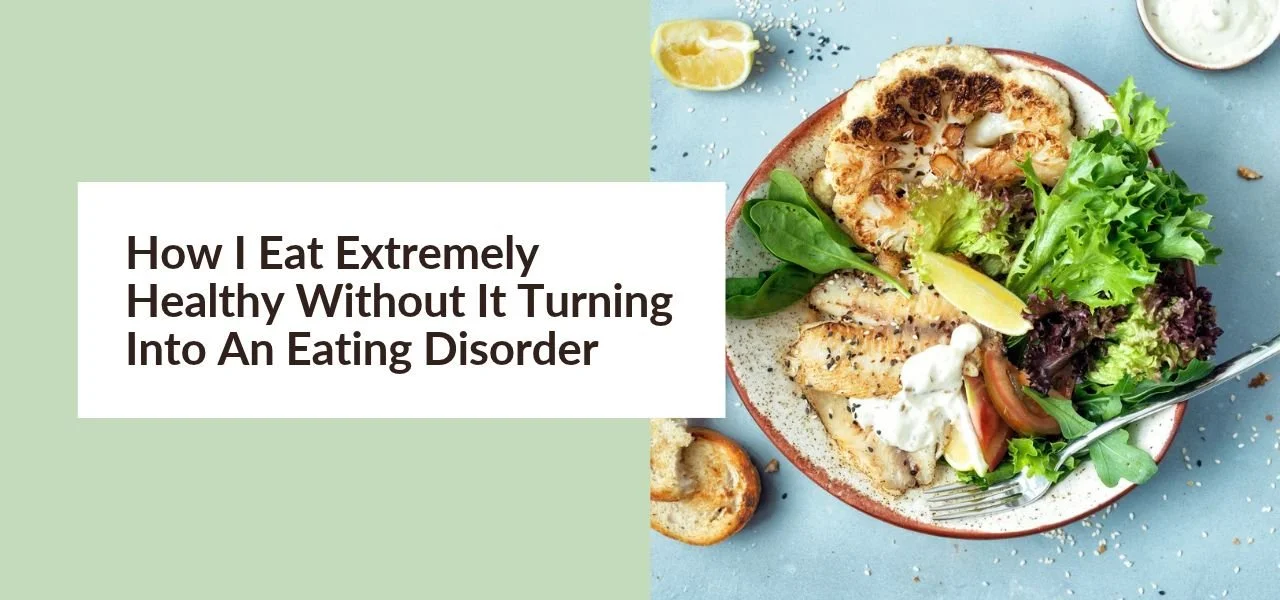
7 years ago, I ate extremely healthy, but I had an eating disorder.
I was always stressed and anxious about what I was eating, when I was eating, and I felt so restricted that I ended up binge eating at night on all of the processed foods that I had just sworn off for the day.
But today I’m able to eat healthy after an eating disorder without it turning into an eating disorder again. I rarely eat processed foods or sugar and the craziest part of this to me is that it feels so dang easy.
There are several key differences that have changed in my eating habits and my mindset around food, so by the end of today's episode, you'll understand why going back to healthy eating has felt dangerous before and how you can make it feel safe and actually truly healthy now instead of disordered.
You’ll also learn…
Healthy eating vs orthorexia
How to handle food sensitivities with an eating disorder history
Warning signs of orthorexia
How to Eat Healthy Without an Eating Disorder
So many of my clients have come to me after recovering from what they consider a more serious eating disorder. Binge eating itself is serious, but a lot of times, we think of things like anorexia, bulimia, or orthorexia as more serious.
Some of these clients have come to me after therapy feeling like they're not allowed to pursue healthy eating anymore. They worry that if they want to eat cleaner or have less sugar, it means they're going back into their eating disorder.
It's a really fine line to balance.
Maybe you're not feeling good in your body. You're feeling sluggish, unenergized, and you're not sleeping well. You know that eating healthier might help, but you're scared of going back to your old eating habits.
And that fear makes sense. When you've recovered from something, even if you've only partially recovered, it can feel scary to think about going back to a place where you had a full-blown eating disorder.
Maybe your eating disorder happened 20 years ago when you were in high school, but you're still afraid of returning to that place.
You might even have tried cutting back a little or thought, "I want to lose a little weight," only to find that your binge eating got worse.
Now you've realized that you can't restrict, but you're not sure what to do to eat healthier.
The good news is that you don't have to choose between eating healthy and having a healthy relationship with food. You can work toward both.
What Disordered Eating Looked Like for Me
For me, disordered eating looked like so much fear. That's what I remember most from those days.
I couldn't go out to eat at restaurants without panicking about calories and other things. Yet it was so ironic because I'd go home and binge on all those calories anyway.
I remember once I even had a panic attack at Red Robin because I couldn't decide whether I was going to allow myself to have the unlimited French fries or the unlimited broccoli.
I literally had a panic attack. I had to go to the bathroom, and I told my family, "Just order whatever you want for me when the waiter comes around. I just don't care."
I think they ended up ordering the broccoli, but I was so stressed. It was so scary to think about choosing the French fries.
Today, I might go and order the broccoli. Or maybe I'll get the French fries because the French fries at Red Robin are really good!
But if I chose the broccoli, it wouldn't feel restrictive. I wouldn't feel deprived. It would just feel like an easy choice because maybe I'd already had French fries that day, or the broccoli genuinely sounded better.
That's the difference.
The food itself doesn't tell you whether your eating habits are healthy or disordered. How you feel about your food choices matters, too.
How to Know If You're Eating Healthy or Slipping Back Into an Eating Disorder
There are two main things I want you to look at when you're trying to figure out whether you're eating healthy or starting to slip back into disordered eating.
1. How Do You Feel Emotionally Around Food?
Do you feel anxious, stressed, and fearful around food? Or do you feel calm and empowered?
You can be eating almost the exact same meal and the exact same foods but have completely different thoughts and feelings about them.
Those thoughts and feelings can determine whether you feel fearful and stressed around your food choices or calm and comfortable with them.
All of our thoughts create our feelings, and our feelings drive our actions.
When we're feeling stressed and anxious, we're probably more likely to overeat or undereat. We end up eating in a way we don't actually want to eat because our actions are being driven by those thoughts and feelings.
So, check in with yourself.
Does this food decision feel like anxiety or peace?
2. How Do You Feel Physically?
Next, look at how your body feels.
If you're feeling sluggish, experiencing brain fog, dealing with low energy, or not sleeping well, these can be signs that your healthy eating habits have become disordered.
You might not be getting enough food or enough nutrients. You might not be eating a certain type of food enough.
But there's another possibility you might not have considered. The general stress you're experiencing around food can also contribute to these symptoms.
Stress is one of the hardest things on our bodies. It can wreak havoc on so many things. If you're constantly stressed about your food decisions, that stress can affect other areas of your health, too.
So, if you're not feeling good emotionally or physically around food, we may or may not need to change much about your actual eating habits. Sometimes, we need to change the way you're thinking about food.
And that's something I approach on a client-by-client basis.
You Don't Have to Give Up Healthy Eating to Recover From Binge Eating
I think a lot of people get scared to ask for help because they think I'm going to make them eat junk food all day, encourage them to overeat, or tell them they just have to accept the weight they're at.
But I'm not one of those coaches. That's not what I do.
I never make my clients do anything they don't want to do, and I don't encourage them to eat lots of junk food. I also don't tell them they have to give up their health or weight goals.
I do encourage you to accept your body where it is right now and approach your weight loss goals from a place of love. I also want you to have balance with food so you can eat everything in moderation.
I'm never going to tell you that you have to start eating more unhealthy to recover from binge eating.
I don't know where that idea came from, but it's crazy to me that some people fear recovery because they think they'll have to give up all their health goals.
I want you to eat extremely healthy because I want you to be in the best health of your life.
But I want you to do it in a way that feels fun, light, easy, and effortless. I want it to be something you can take with you anywhere in the world.
That's exactly how my eating habits feel now.
I travel all the time. I love living in different locations and being able to go wherever I want. If my food choices caused me stress, I wouldn't be able to do that.
Because eating is so easy and effortless now, I can go wherever I want while still making choices that feel good in my body.
I feel good physically and mentally from my food choices, and I'm not stressed about all the food rules and food noise I used to deal with, especially when traveling.
That's what I want for you, too.
5 Changes That Helped Me Eat Healthy Without an Eating Disorder
My day-to-day meals might look similar to what I ate when I was struggling with disordered eating. But my relationship with food has changed in some important ways.
Here are five things that have made a difference.
1. I Don't Restrict How Much Whole Food I Want to Eat
When I was binge eating, I actually ate a lot less during the day because I was trying to save food for later in case I binged that night.
I would undereat so much that it felt like I was barely eating anything all day. But when you added everything up, I was eating a lot.
Now, I genuinely eat until I'm full and satisfied.
I don't restrict the amount of real, whole foods I want to eat. I used to think, "Even healthy foods have calories, so I better be careful. I don't want to overeat on salad because there's still dressing," or, "I don't want to overeat on peanut butter because it's still really high in fat."
Now, I give myself permission to eat enough.
Eating enough during the day is part of eating healthy. The healthiest thing I ever did was stop saving my food for later in case I binged.
Ironically, when I started eating more and eating healthier in a way I genuinely enjoyed, I lost about 20 to 30 pounds of my binge weight.
I wasn't doing it the way diet culture had told me to eat healthy. I was learning to enjoy eating healthy without restricting myself.
But giving yourself permission to eat enough can be difficult when you're alone and that fear kicks in.
What if I gain weight?
Suddenly, eating enough starts to feel wrong, and it's easy to slip back into thinking, "I'll just be good today."
If that sounds familiar, remember that eating enough is not something you need to earn. You can take care of your body without using restriction to control it.
2. I Eat More Balanced Meals
I used to heavily restrict my carbohydrates and fats. I'd try to eat little portions of everything, including protein and vegetables, and then call it good.
Now that I'm no longer in that disordered eating space, I give myself permission to have the carbohydrates and fats I want while paying attention to how food feels in my body.
I'm not following a bunch of external rules about how much of each food I should eat.
Instead, I'm paying attention to my body's feedback.
3. I Listen to My Body Instead of Outsourcing My Eating Wisdom
No one else in my life and no one else on the internet knows what my body needs and how it's supposed to eat.
That has been a huge change for me.
I used to outsource all my eating wisdom to other people. I followed what my mom said or what someone on TikTok told me.
Now, I pay attention to what my body says.
What feedback does it give me? How do I feel after eating certain foods? What choices help me feel good?
For example, I don't really eat dairy anymore. Some people might consider cutting out dairy disordered and assume I'm slipping back into my eating disorder.
But I've noticed a connection between eating dairy and how I feel in my body, particularly with my skin. When I eat dairy, I experience much worse cystic acne. I also notice a phlegmy feeling in the back of my throat and a stuffy nose.
Those are the experiences I've noticed in my own body. I'm not avoiding dairy because someone told me I have to follow a strict food rule. I'm making a choice based on what I've observed about how I feel.
The same idea applies if you've noticed that certain foods don't make you feel good. Your choices can be informed by your own experiences rather than fear or someone else's rules.
I've helped a lot of people work through their feelings around food sensitivities, too.
At first, cutting out dairy felt like being on a diet for me. I rebelled against it, and then I binged more on dairy foods. I had to change my mindset so that my decision became a guideline that felt easy rather than a strict rule.
And that's an important distinction.
4. I Don't Panic When I Can't Eat Perfectly
In the past, if I wasn't 100% perfect with my clean eating plan, I went 100% off track because I thought I'd already blown it.
I'd cut out sugar, then binge and hide it because I felt so much guilt and shame about breaking my rule.
Afterward, I'd vow never to eat that food again. I wasn't making that decision because I genuinely cared about feeling good in my body. I was doing it out of fear of gaining weight and losing control around food.
I experienced something similar with dairy. I thought I had to be 100% perfect about avoiding it.
Now, sometimes I have cheese or pizza, especially when I'm traveling. I might have less control over my food choices when I'm away from home because some restaurants don't have as many options. Sometimes, I also genuinely want to have a little cheese.
If I choose to have some, I don't panic about it.
I know it might not make me feel my best, but I don't turn that into a strict rule that I can never eat it again. I simply make the choice that feels right to me in that moment.
It's kind of like buying a designer purse. I'm not saying I'm not allowed to buy one or that I don't have the money for one. I'm saying that spending a few hundred or a few thousand dollars on a purse doesn't feel worth it to me because I'd rather use that money elsewhere.
It's the same with food. Most of the time, I'd rather choose other foods that make me feel better in my body.
It doesn't have to be a strict rule. It's just a choice that feels right for me.
No Food Choice Morally Defines Me
One of the things that has helped me so much with all-or-nothing thinking is reminding myself that no food choice ever morally defines me.
I'm not a better or worse person because of what I eat today.
Sometimes I want something sweet. Sometimes I have cake at a birthday party. Instead of letting that turn into "screw it" for the next couple of days, I remind myself that this decision doesn't make me a better or worse person, and then I move on with my life.
This can be difficult when you've accumulated food rules throughout the years. The second you eat something you've labeled as a "bad food," your brain can go straight back to those old thoughts.
I've ruined it. I've messed everything up. I'm off plan.
This is one of the things we often work on inside the Confident Eater Program during our weekly rewire coaching sessions.
We examine the food rules you've accumulated over the years and ask whether they're actually helping you stay healthy and feel good or whether they're keeping you stuck in disordered eating and making your life worse.
5. I've Trained My Brain to Genuinely Want Processed Foods Less
The final thing that's changed is that I've trained my brain to genuinely want processed foods less.
It's not a rule someone else gave me or something I feel forced to follow. I've learned to decrease my desire for processed foods, so I genuinely don't want them as much.
And if I decide to have them, I know how to approach them without feeling restricted or deprived.
My thought is simply, "This is just not something I do anymore."
I recently taught this process to one of my clients who had struggled with soda for most of her life. She came back to one of our sessions and said she couldn't believe how natural it felt to think, "I just don't drink soda anymore."
She'd been drinking soda every day for at least 10 years, and she had struggled with the sugar and caffeine in it.
Now, she sees soda and thinks, "I just don't do that anymore."
It's not a big deal for her to say no. She doesn't feel restricted or deprived. She's not white-knuckling her way through cravings.
She's simply making a choice that feels natural to her.
That's something we worked on together during our coaching session.
What If Other People Think Your Healthy Eating Is Disordered?
Some people in your life might still think the way you eat is disordered. But that isn't necessarily for them to decide.
I was talking to a client who told me that everyone in her life had recovery goals for her. Her therapist, mom, family, friends, and coworkers all had a specific idea of how they thought she should eat and how much food she needed.
Because she's on the thinner side, people assumed she needed to eat more.
Sometimes, she was eating in a way that felt good and healthy to her, and she was genuinely full and satisfied. Yet some people around her still thought her eating was disordered.
To that, I say, allow them to think that while continuing to pay attention to your own well-being and seeking appropriate support when you need it.
Some people might think my eating is disordered, too. They might wonder why I look for organic protein at the grocery store or try to avoid seed oils.
But I make those choices because of how I believe those foods affect my health and how I feel about those decisions.
It's interesting that people can view a choice as disordered even when it feels good to you. But remember, my mindset around food has changed, too. There was a time when eating this way probably would have caused me a lot of stress and anxiety.
The difference isn't just what you're eating. It's the mindset you're bringing to your food choices.
Would How You Eat Today Be Disordered 100 Years Ago?
Here's a fun question you can ask yourself:
Would how I eat today be disordered 100 years ago?
This can help you think about your eating habits a little differently.
Imagine someone 100 years ago restricting themselves all day, eating a salad with no dressing and some grilled chicken, pushing off their hunger, and then binge eating at night.
That pattern of restriction and binge eating would still be concerning.
But 100 years ago, we didn't have Oreos, Cheez-Its, and fast food on every corner.
I don't think choosing not to eat those foods automatically means you're engaging in disordered eating. If you saw someone in 1926 eating the way I eat today, you might simply see it as normal.
Our food environment has changed. We're surrounded by processed foods, added ingredients, and opportunities to eat foods that might not have been as readily available in the past.
Think about how often cookies are available at events, parties, and gatherings. During the holidays, there are Halloween candies, Christmas cookies, and desserts everywhere.
It can feel strange to say no to those foods when they're constantly available. But choosing not to eat something doesn't automatically mean you're restricting in a harmful way.
What matters is why you're making that choice and how you feel about it.
Are you choosing the food because you genuinely want it, or are you afraid of what will happen if you say no?
If you're thinking, "I'm going to binge if I say no to this food," that isn't necessarily a problem with the food itself. It may be a mindset issue that needs attention.
You can learn to make food choices without fear, guilt, or the feeling that one decision will ruin everything.
What Are the Warning Signs of Orthorexia?
Now, here are the warning signs I want you to look out for so you can recognize when your healthy eating might be starting to turn into a problem.
It's good to be aware of these signs so you can pay attention to what's happening and get support when you need it.
Here are some things to look out for:
You feel anxious or guilty when you can't eat your preferred foods. You might feel stressed when your usual foods aren't available or when you can't follow your eating routine.
Your list of safe foods keeps getting shorter and shorter. You continue eliminating foods because they don't fit your idea of healthy eating, leaving you with fewer and fewer options.
You hide what you eat. You might feel ashamed about eating certain foods or feel the need to keep your eating habits a secret.
You feel proud of how little you ate throughout the day. Eating less becomes something you use to judge yourself or feel good about.
Your healthy days are followed by nighttime binges. You restrict or try to be good during the day, only to find yourself binge eating later.
If any of these sound familiar, it may be a signal to get support and look at these patterns more closely.
You don't have to wait until things get worse before asking for help.
We live in a diet culture society, and people aren't always taught how to eat in a way that's both nourishing and flexible. It's normal to feel confused or unsure about whether your eating habits are healthy or disordered.
You don't have to figure it all out on your own.
How to Get Help With Disordered Eating
If you're struggling to figure out whether your eating habits are healthy or disordered, this is something I help people work through inside my Confident Eater Program.
I have every client complete a basic food diary, and I look it over to give them actionable suggestions based on what I've learned over the years about what can make a difference when you're working to stop binge eating.
I look at whether you're eating enough of the right things because that can make a big difference.
But for some people, we don't need to change much about the food itself. We need to work on how they're thinking about food.
That can be hard to do on your own because these beliefs and food rules may have been part of your life for years.
Inside the Confident Eater Program, we work through those beliefs during our weekly rewire coaching sessions. We look at the food rules you've accumulated and whether they're helping you feel healthy or keeping you stuck in disordered eating.
I want you to be able to eat healthy without feeling like you have to follow strict rules, fear certain foods, or spend your day thinking about what you can and can't eat.
You can learn to make choices that support your health while also having a more peaceful relationship with food.
The Biggest Takeaway: Healthy Eating Should Feel Like Taking Care of Yourself
If there's one thing I want you to take away from this episode, it's this:
Healthy eating becomes safe when you stop using it to try to fix yourself and start using it to take care of yourself.
You don't have to give up your health goals to recover from binge eating. You also don't have to follow every food rule you've ever learned to be healthy.
You can eat in a way that helps you feel good physically while also feeling calm, flexible, and at peace around food.
You can enjoy whole foods, listen to your body, and make choices that feel good to you without turning those choices into strict rules.
And when you do eat something that doesn't fit your usual routine, you don't have to feel guilty or decide you've ruined everything.
Your food choices don't determine your worth.
You deserve to feel healthy without being afraid of food. You deserve to enjoy your life without constantly thinking about what you can and can't eat.
And if you're struggling to find that balance, getting support is a normal and worthwhile step.
You can learn to eat healthy in a way that feels fun, light, easy, and effortless, without letting healthy eating take over your life.