How Sarah Had a Binge-Free Summer Without Tracking Macros (After 10+ Years of Struggling With Food)
August 13, 2026
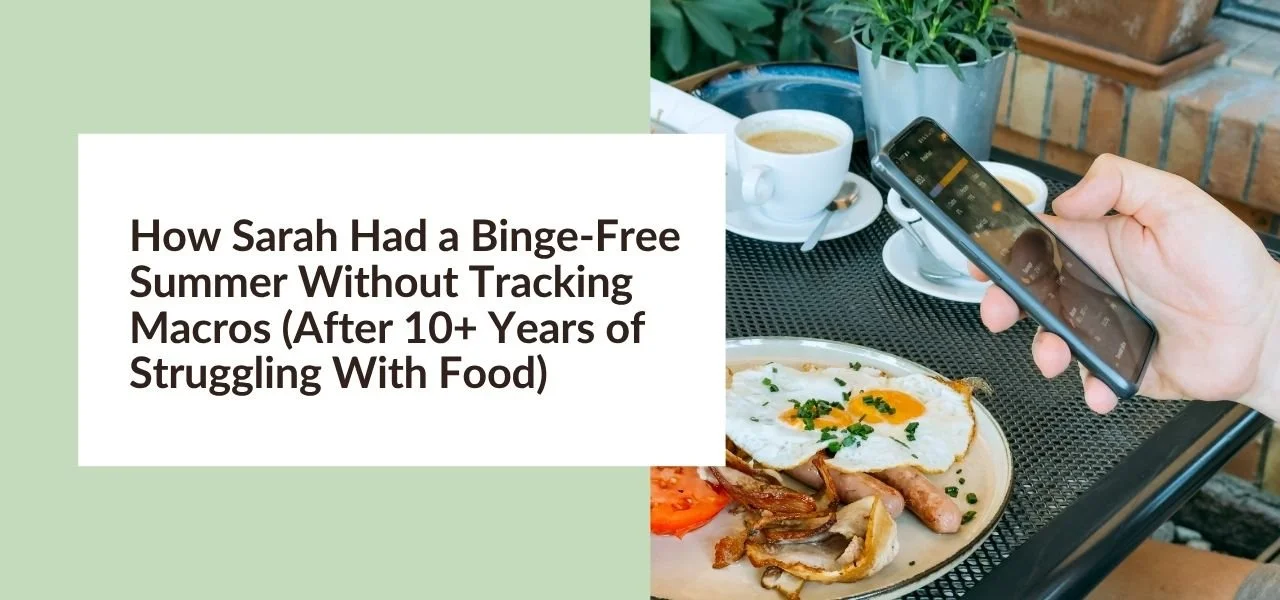
Sarah is a mom of three who spent over a decade stuck in a cycle of restriction and binge eating.
Weekends were her "weak end." Summers felt miserable, alternating between strict macro counting and saying screw it, which often led to her being up 10+ lbs by the end.
And the harder she tried to track and control her food, the worse it got.
Today we talk about what finally helped her stop binge eating.
Why tracking macros was actually making her binge eating worse, not better
The identity shift that helped her go 3 months without bingeing
How summer, holidays, and special occasions went from her biggest triggers to just... normal life
What happened when she stopped weighting herself & tracking and started trusting her body
How she eats anything in moderation now
Does Tracking Macros Cause Binge Eating?
You're doing everything right. You've got your macros set up, you're logging every meal, you're hitting your protein goals during the week. But then something shifts. You go over your calories by a small amount, and before you know it, one cookie becomes eight.
Sound familiar?
If tracking your macros has ever sent you into a spiral of overeating, you're not alone. For many women, calorie and macro tracking doesn't prevent binge eating. It actually makes it worse.
That's exactly what happened to my client Sarah too.
Her story shows why tracking macros and binge eating so often go hand in hand — and what it actually takes to stop binge eating for good.
Why Macro Tracking and Binge Eating Are So Closely Connected
Before Sarah came into The Confident Eater Program, she thought she was doing everything right. She was counting her macros, weighing herself weekly, and trying to stick to her calorie goals every day.
"I thought I was doing everything right because that’s what everyone else told me to do," she said. "What I really found out is that it ended up leading to restriction, which ultimately led to me binge eating again."
She was caught in one of the most common cycles in disordered eating: the restrict-binge loop. Track carefully all week, run out of calories, feel panicked, eat one "off-plan" food, and then lose control entirely.
"I would see, 'Oh, I only have 200 calories left,' and I would panic, and then I would end up eating a cookie. And all of a sudden I would eat eight cookies."
When food gets reduced to numbers, any deviation from the plan feels like failure. And once failure is registered, the all-or-nothing brain kicks in: I already ruined it, so I might as well keep going. That one cookie becomes the whole bag.
The Hidden Way Macro Tracking Fuels the All-or-Nothing Mindset
For Sarah, the tracking wasn't just a practical tool. It became the lens through which she judged her entire day and herself.
"It was like I had to be perfect, or I would completely fall off the bandwagon and eat until I was ashamed."
This is what makes tracking particularly problematic for people prone to binge eating.
The moment the numbers say you've hit your limit — whether you feel satisfied or not — your brain registers scarcity. And scarcity, for anyone with a history of restriction, is the trigger that sets off a binge.
When your brain believes food access is being controlled and limited, it goes into a kind of survival overdrive. The same drive that helped our ancestors survive famine is now working against you every time MyFitnessPal tells you you've hit your limit.
What Happens to Your Body When You Stop Tracking
Letting go of macro tracking can feel terrifying — especially when it's been your sense of control for years. Sarah felt the same way.
"I knew that if I really wanted to stop binge eating, I needed to let go of that control, which really was leading to lack of control."
That phrase is worth sitting with: the control that was leading to lack of control. The very thing that felt like safety was the thing keeping her stuck.
When Sarah stopped tracking, something unexpected happened. Rather than spiraling into chaos, she started to hear her body again.
Her energy stabilized. The bloating she'd lived with for years started to clear. Her mood improved. And the weekend binges that had defined her life for decades — the ones that had her eating birthday cake alone after her daughters' parties, the ones that turned every summer lake day into a food free-for-all — began to disappear.
The Protein Bar Problem: When "Healthy" Foods Keep You Stuck
One of the most surprising shifts Sarah made had nothing to do with willpower or mindset — it was about the foods she was eating between meals.
She was relying on protein bars and protein shakes as snacks, the kind that are marketed as low-calorie, high-protein, and perfect for people trying to hit their macros. She loved and looked forward to them.
But they weren't doing what she thought.
"What I found is it actually left me wanting more and still hungry. So once I switched to more whole foods, my body was able to say it knew it was full and satisfied."
Highly processed diet foods, even the ones with impressive macros on the label, often don't trigger the same satiety signals as whole foods. Your body gets the protein numbers but not the actual fullness. So you stay in a low-level state of hunger that, over time, builds into a binge.
Switching to real food — not "clean eating," not another set of rules, but actual food — helped Sarah's hunger cues come back online. And once she could feel hunger and fullness again, the bingeing had far less power over her.
"I Don't Have to Be Perfect to Be in Control"
One of the biggest shifts Sarah described wasn't about food at all. It was about identity.
For years, her relationship with food was binary. A good day or a bad day. On the plan or off it. In control or completely out of control. The numbers gave her something to measure herself against — and she was constantly falling short.
Working through The Confident Eater Program, she started building a different kind of relationship with herself around food.
"If I come home and I overeat, I can now say, 'Why did I do that? What did I need in that moment?' And I learn from it. Instead of having shame or guilt or starting over, I get to just say, 'I think I was overwhelmed, or I was tired, or I needed rest,' and we get to move on."
This is what actually stops binge eating — not tighter tracking, not more macro precision, not a better app. It's the ability to respond to a difficult moment with curiosity instead of shame.
How Giving Yourself Permission to Eat Actually Reduces Cravings
This might be the most counterintuitive part of Sarah's story — and the one that surprises most people the most.
When she stopped restricting and started giving herself genuine permission to eat what she wanted, the urgency around those foods decreased.
"Once I gave my brain permission, it almost didn't want it so bad. When you binge, it's not even like what you want. It doesn't even taste good. You're just on autopilot."
Sarah can now eat a cookie on a Monday and move on.
What Sarah's Life Looks Like Recovered From Binge Eating
Today, Sarah doesn't count macros. She doesn't track calories. She doesn't weigh herself weekly.
And the things that used to terrify her — Easter, birthday parties, summer lake days, holidays, going out to restaurants — no longer send her into a spiral.
"I don't feel so anxious going into holidays, weekends, the summertime, birthday parties. I finally feel like I can trust myself."
She also described something she hadn't expected: the impact on her daughters.
"I have three girls of my own, and I didn't want that for them. Now I feel like I can be a good example for my daughters."
FAQ: Tracking Macros and Binge Eating
Does tracking macros cause binge eating? Not for everyone — some people track macros without any issues. But for those with an all-or-nothing mindset, a history of restriction, or a tendency toward perfectionism, tracking can fuel the restrict-binge cycle by turning food into a pass/fail system. If tracking is making you feel panicked, guilty, or out of control, that's a sign it may be doing more harm than good for you specifically.
Why do I binge after hitting my calorie limit? When your brain registers a calorie ceiling, it can trigger a scarcity response — the all-or-nothing thinking that says "I've already blown it, so I might as well keep going." This isn't a character flaw. It's the predictable result of using rigid numbers to manage eating when the underlying relationship with food hasn't been addressed.
Can I stop tracking macros without gaining weight? Many people find that when they stop tracking and start listening to their body's hunger and fullness signals, their weight actually stabilizes. The restrict-binge cycle itself often drives weight fluctuation. Removing the restriction removes the pendulum swing.
How do I stop bingeing without tracking? The key is addressing what the tracking was masking: the emotions, habits, triggers, and beliefs that were driving the binges in the first place. For most people this means working on the all-or-nothing mindset, reconnecting with hunger and fullness cues, and building new responses to stress and emotional triggers — not just swapping one food rule for another.
Is it normal to binge more when I first stop tracking? It's common to feel disoriented when you first let go of tracking because the structure it provided — even if it was causing harm — felt like safety. This phase is temporary. With the right support, most people find that the urge to binge decreases significantly once restriction is removed.
Ready to Stop Binge Eating?
If Sarah's story resonates with you, and you're tired of doing everything "right" with your macros only to find yourself bingeing again by the weekend, I'd love to talk.
The Confident Eater Program is designed specifically for women who feel like they know what to do, but need to understand why they keep getting stuck and how to actually change.