What to Do After a Binge: A Step-by-Step Guide
August 20, 2026

You just binged and you feel awful.
So you do what most people do. You frantically google "how to recover from a binge" and get told to drink some water and move on.
It never feels like enough. So the next day you try to eat a little less, and before you know it you're bingeing again that same night.
You wish you just had a step by step plan that actually worked. That's exactly what this episode gives you.
Today you’ll learn the common mistakes most people make after they binge, plus the 4 steps to recover from a binge.
What Not to Do After a Binge
The biggest thing people often do after a binge is start beating themselves up. That can quickly turn into restriction.
After a binge, you might try to make up for it by exercising hard, cutting back on food, trying to be good, or telling yourself you’ll start fresh on Monday. I used to do this because I thought I was being productive and somehow making up for all the calories I had just eaten.
But what this actually does is set you up for the next binge. It puts you into the binge restrict cycle, a never-ending loop where the binge is followed by restriction, which eventually leads to another binge.
The binge almost never starts with the binge itself. It’s happening in the hours and days before that, and it all builds up to that moment.
So instead of thinking, “How do I recover from this binge?” I want you to reframe it as:
How can I avoid making the decisions that will cause the next binge?
Will One Binge Ruin Your Progress?
No. One binge does not mean you’ve ruined everything or gone back to square one.
After a binge, you might start telling yourself things like:
“I ruined it.”
“I might as well keep going.”
“I’ll never be able to do this.”
“There’s no point in trying.”
Those thoughts can leave you feeling hopeless, and when you feel hopeless, you’re much more likely to give up and keep eating.
Your brain can actually tell you these stories because it thinks it’s protecting you from disappointment. If you convince yourself there’s no point in trying, then you don’t have to deal with the disappointment of potentially bingeing again.
But that just keeps you stuck.
The Other Extreme: Pretending the Binge Never Happened
On the opposite side of beating yourself up, you might try to shove the binge under the rug and pretend like it never happened.
You might think, “If I just don’t think about it anymore, maybe it will disappear.”
That can feel nice in the moment because you’re avoiding the guilt and shame, but you’re also missing an opportunity to learn from what happened.
The binge happened for a reason. If you don’t take the time to figure out why, the same pattern can keep happening.
What we want is the middle ground: acknowledge that you binged without beating yourself up for it.
What to Do After a Binge
Step 1: Stop the Punishment
Stop trying to punish yourself for bingeing.
Yes, you deserve kindness and self-love, but there’s another important reason not to punish yourself: guilt and restriction are the exact fuel binge eating runs on.
A binge is an opportunity to see where growth needs to happen. Instead of using guilt and shame to force yourself to do better tomorrow, use this experience to understand what needs to change.
Step 2: Eat Your Next Meal Normally
Your next step is to eat your next meal normally, as long as you have some hunger for it.
Instead of thinking about what you “should” eat because you binged, pretend you never had the binge and ask yourself:
“If I didn’t binge last night, how would I go through the day and eat?”
Maybe you’d have your normal yogurt bowl with granola and fruit, plan a snack, have your usual lunch, and make dinner with your family.
Whatever that looks like for you, allow yourself to return to your normal eating instead of trying to compensate for the binge.
I also have an episode specifically about whether you should eat dinner after a binge, where I go more in-depth on this question.
Step 3: Get Curious, Not Critical
Before the binge fades away from your memory, there is a lot of data you can gather.
Ask yourself:
What was happening that day?
What were you thinking right before the binge?
What was happening in the hours leading up to it?
You’re not using this information to beat yourself up. Your patterns are information, and information is power.
Inside the Confident Eater Program, I have a full module plus a worksheet specifically designed for the aftermath of a binge because this moment can be one of the highest leverage moments to change the pattern.
Instead of getting stuck in guilt or shoving the binge under the rug, you can use it as an opportunity to understand what happened and move forward.

Step 4: Decide What the Next 24 Hours Will Look Like
Don’t make a 20-step plan for how you’re going to get healthy after a binge.
Making a big resolution after a binge is a trap because your brain cannot follow through on giant changes, especially when you’re already feeling physically and mentally low.
Instead, ask yourself:
“What do I want the next 24 hours to look like?”
Don’t make this about eating perfectly or completely changing your eating habits. Go into the place of:
“What would a normal day of eating look like for me?”
Even if it’s not a perfect day of eating, allow that to be part of your next step.
You might also:
Fill up your water bottle so it’s ready for the next day.
Take a gentle yoga class if movement genuinely feels good.
Go for a longer walk or run if you actually want to move your body.
Journal and reflect on what happened.
Take a bath or shower and notice another form of pleasure and self-care.
The important thing is to check in and make sure these choices aren’t coming from punishment.
How to Stop a Binge Before It Happens
Of course, the best way to deal with the aftermath of a binge is to prevent the next binge from happening in the first place.
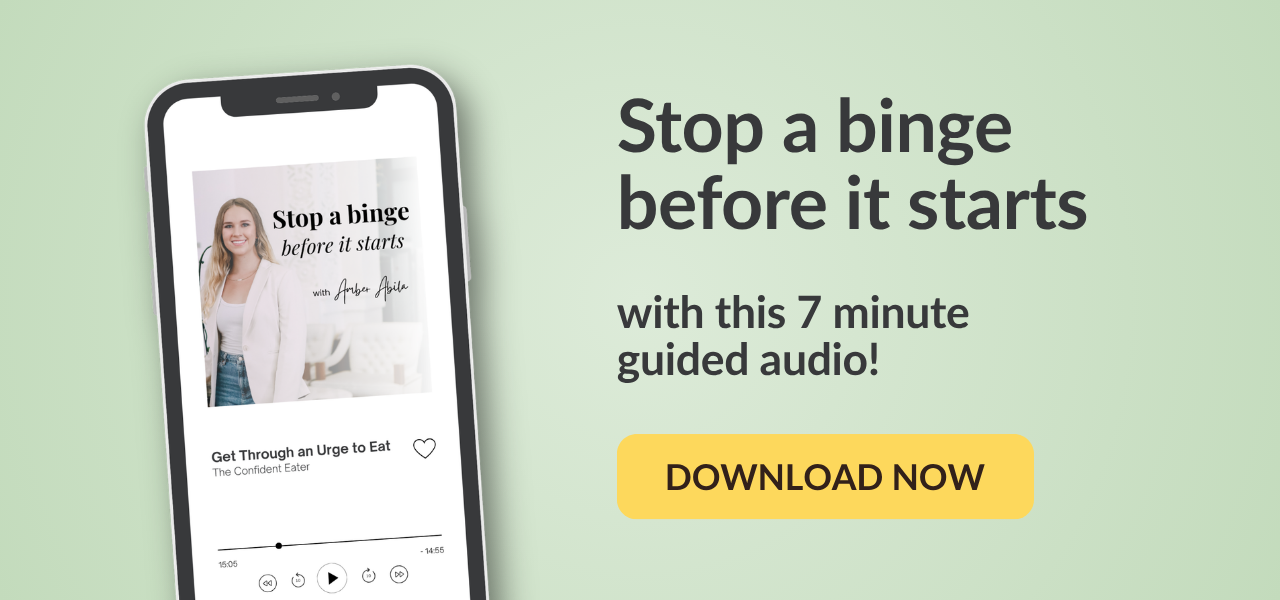
If you don’t already have my free Stop a Binge Before It Starts guided audio, it’s a seven-minute guided audio you can pop in your ears when you’re having strong cravings and want help getting through the urge before it turns into a full binge.