You Won't Stop Overeating For Good Until You Understand This
August 27, 2026
I know what it’s like to be tormented by sugar cravings all day.
To feel like no matter what tips you find online or how many therapists you talk too, you just can’t stop eating.
I would throw food away in the trash only to pull it minutes later, trying to find the bits that didn’t touch anything else and still eat it.
Put my chips in a bowl to control my portions only to continue eating the whole that night.
Feel like I couldn’t get through a single day without food noise consuming my brain.
I spent every morning, every Monday, every new month and new year promising myself that I would eat healthier and get it together but food felt like an addiction to me.
What I’m talking to you about today is the secret to how I finally stopped overeating for good, eliminated my sugar cravings, lost 30 lbs, and have the healthiest eating habits of my life without an eating disorder.
Is Overeating a Willpower Problem?
Let's start from the beginning with the story that we've all been sold: binge eating is a willpower problem. You just need to try harder, get more discipline, more structure, more control.
But the problem with that story is it doesn't actually work. You are disciplined in other areas of your life. You've probably done a lot of things that are genuinely hard. For myself and most people in my program, willpower is not the thing you're missing.
If willpower was working, it would've already fixed this, and it hasn't.
Why Do I Overeat Certain Foods?
You don't binge on grilled chicken or plain broccoli. Almost nobody has ever lost control and eaten four servings of steamed vegetables at 10:00 PM.
There is a reason for that, and it's not that there's something broken with you. It's something that goes on chemically in our brain and bodies, and it's by design.
What Is the Bliss Point in Processed Foods?
Food companies have employed many food scientists whose entire career and job is to find what's called the bliss point. The bliss point is the exact ratio of sugar, fat, and salt that maximizes how much your brain wants to keep eating without ever feeling fully satisfied.
A key ingredient involved here is flavorings. Additional flavorings and isolated molecules can trick our brain into thinking that we're eating something more nutritious than we actually are.
We're not just these out of control monstrous beings with an insatiable need for carbs and sugar. This doesn't happen with real foods in the same way.
Want to go deeper into how flavorings affect cravings? I also have a full episode on flavorings that goes much more in-depth on this topic.
How Processed Foods Affect Hunger and Fullness
When we're eating real whole foods, we get the "okay, that's enough" signal. But processed foods with added flavorings are formulated to delay that enough signal for as long as possible.
A fascinating 2019 study from the National Institutes of Health compared an ultra-processed food diet with a whole food diet. The diets were matched calorie for calorie, sugar for sugar, fat for fat, and fiber for fiber. Participants were allowed to eat as much or as little as they wanted.
When people had the ultra-processed food diet, they ate about 500 more calories a day without noticing or intending to. They also ate faster, their bodies produced different hormone responses, and they gained weight in just two weeks.
Why Calories Aren't the Whole Story
I used to be a big calorie counter, and I was so scared to stop counting calories because I thought my body wasn't going to know what to eat. But our bodies are not machines like that. Our bodies are so complicated, with so many different mechanisms involved.
Restriction and Overeating: Why They Work Together
Restriction is not telling yourself no to a cookie. That can be self-care. Restriction is when we're not getting enough calories or nutrients.
When we're not eating enough and then we start eating processed foods, your brain is really going to treat that first bite as extra urgent because, as far as your body is concerned, food might be scarce again soon.
So if you have restriction plus hyperpalatable food, that is close to the worst possible combination for triggering a binge. These are two mechanisms that will compound each other when they're put together.
How to Stop Overeating Without Relying on Willpower
So if the answer isn't just having more willpower, what is it? I'm going to give you five steps that can help you stop overeating unprocessed foods specifically.
1. Stop Treating Overeating as a Discipline Problem
The single biggest mental shift you can make is to stop asking yourself, "What's wrong with me?" and start asking, "What is happening in my brain and body right now?"
This question alone will take so much shame out of the equation. If we release the shame and learn more about why this is happening, we don't actually have to try harder.
2. Build Meals Around Protein, Fiber, and Fat
I want you to build meals around protein, fiber, and fat instead of restricting yourself. We want to think about how we can add in more of these whole foods with these nutrients versus cutting out foods.
When we have foods with protein, fiber, and fat in them, that helps stabilize our blood sugar so we don't have hormonal hunger all day. That means fewer crash and crave moments to fight in the first place.
3. Change Your Food Environment
Willpower is a terrible long-term strategy against something engineered to beat willpower. Instead, change your environment.
This doesn't mean you need to have a rule that you're never going to buy processed foods or have anything with added flavorings or sugar. Just look at what's easy to grab in your kitchen and what's at arm's reach versus what takes effort to get.
Make the things that support you more accessible so your brain doesn't have to fight this uphill battle every day.
Try Simple Food Swaps
Another thing you can think about is making simple replacements. I have a free Summer Food Swaps resource that gives you ideas for reducing your cravings and making some of these changes easier.
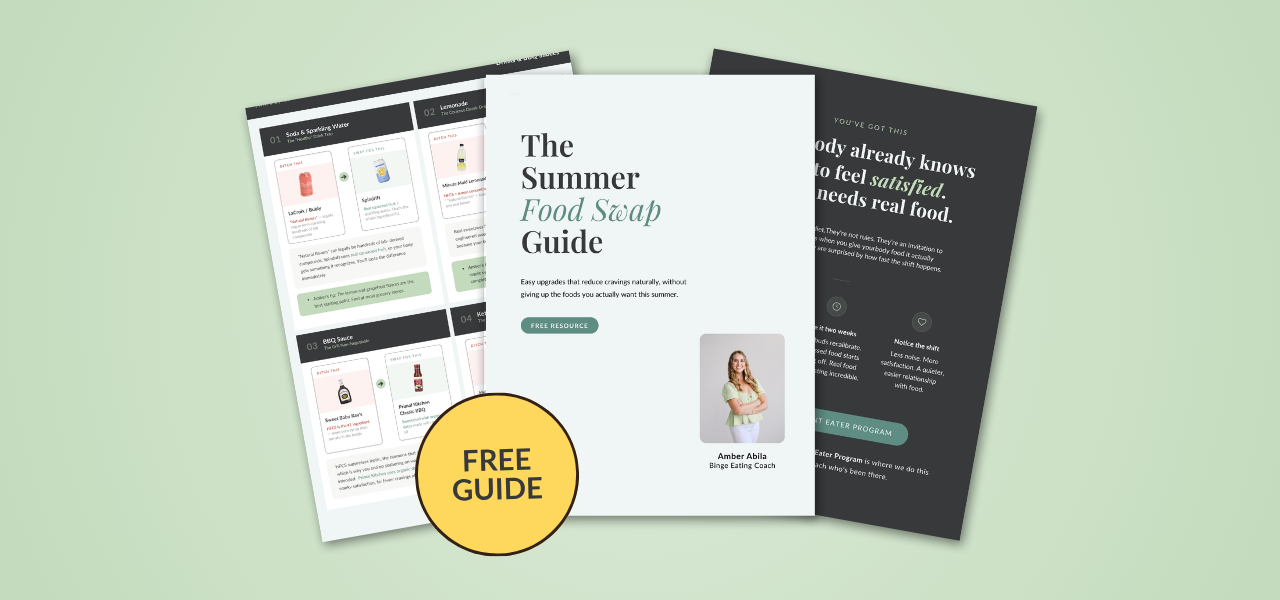
Even if you're listening in the middle of winter, you'll understand what these food swaps can do for you and get ideas for some favorite brands that I love.
4. Interrupt the Overeating Loop Earlier
Start paying attention to when your cravings come up. The earlier you can notice them, versus the 10th bite, the more room you will have to respond differently.
Ask yourself:
When do my urges to overeat get the worst?
When do I notice them?
What do I want to think and do instead?
We're trying to catch that urge before the loop fully engages and we become triggered.
If you haven't already, my guided audio to stop a binge is another free resource that can help in these moments.
5. Get Support
If this is a frequent, distressing pattern in your life, it's usually not solved by information alone.
You can know all of this information, but if your brain is still telling you desirable thoughts around food, it's hard to make permanent changes with food. This is why I work with clients on the mindset piece and helping them change those thoughts around food.
You Don't Have to Keep Fighting Food With Willpower
If you've spent years being told that overeating is about willpower, I hope you can start looking at it differently. A really big portion of this problem can come from the fact that your food has been engineered deliberately to override the signals that normally tell you when you're full.
Your brain isn't malfunctioning here. Understanding what's happening in your brain and body gives you a different place to start, one that doesn't require you to keep beating yourself up and trying harder.
Stop a Binge Before It Starts
If you want help working through those intense cravings before they turn into a binge, grab my free 7-minute guided audio, Stop a Binge Before It Starts. It's a tool you can put in your ears when you have those strong cravings and need help interrupting the loop.