November 26, 2026
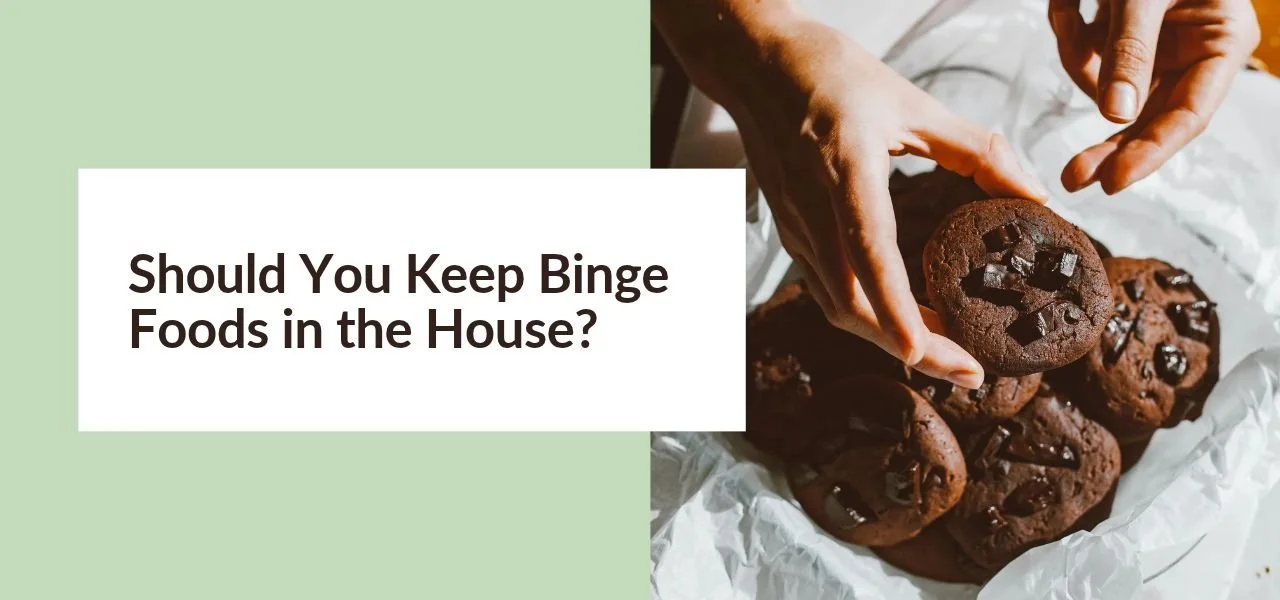
If you binge on certain foods, should you just stop buying them?
Or does that just make you crave those same foods & binge more?
Today we’re talking about one of the most popular questions I get asked- should you keep binge foods in the house?
You’ll learn…
The pros and cons of storing binge foods at home
What are some healthy alternatives to common binge foods?
Is it wrong to keep your binge foods out of the house if you have kids that like them?
What I personally do about former trigger foods
How to create an abundance mindset around food
What Are the Pros and Cons of Storing Binge Foods at Home?
The logic seems simple. If you binge on Oreos, just stop buying Oreos, right?
But then you might find yourself binge eating on some other combination of chocolate chips and peanut butter. So is eating healthy as simple as buying fewer unhealthy foods? Maybe not.
On the other hand, having your trigger foods in the house can make it harder to resist the urge to binge. So which approach is actually better?
Before we get into the pros and cons, I want to talk about the food itself because it's important to understand why certain foods can be so difficult to stop thinking about.
Why Certain Foods Are So Hard to Stop Thinking About
Processed foods like chips, cookies, ice cream, and chocolate-covered treats are built to taste a certain way. Food scientists layer sugar and flavor in ways that can confuse the signals in our brains that would normally tell us we've had enough.
So when you find yourself thinking about the same cookies for the third day in a row, try not to immediately blame yourself. Your brain is responding to something that's designed to get that kind of response.
And this isn't just about packaged cookies. Even homemade cookies or a pumpkin pie from Whole Foods can contain processed white sugar. Because that sugar has been isolated from its original source, your brain can associate the sweetness with the other ingredients in the food.
For example, when you eat a sweet pumpkin pie, your brain may associate that sweetness with the pumpkin itself. In nature, finding something especially sweet can signal that it's ripe and nutritious. But that doesn't necessarily mean the pie is providing the nutrition your body needs.
So, does food matter? Yes. It can have a real impact on your cravings and satiety. Even someone who has a completely normal relationship with food will likely eat more cookies when they're available at home than when they aren't.
With that in mind, let's look at the pros and cons of keeping binge foods around.
The Pros of Keeping Binge Foods in the House
You can practice eating these foods in your own space.
One benefit of having trigger foods at home is that you get the opportunity to practice changing your relationship with them in a comfortable environment.
If your only opportunity to eat these foods is at a party or family gathering, it's much harder to pay attention to your thoughts and what comes up for you around that food.
At home, you have more space to notice those thoughts and practice responding to them differently.
If you've spent years dieting and following food rules, this can also help you start neutralizing certain foods. You get to show your brain that you're in charge and that these foods aren't going anywhere if you don't want them to.
You can build an abundance mindset around food.
A lot of people come to me after years of dieting and following rules that they didn't even create themselves.
They've been told what they should and shouldn't eat for so long that their eating goals don't even feel like their own anymore. And naturally, part of you wants to rebel against rules that someone else handed you.
Sometimes, having these foods in your home can remind you that you're a grown adult. You can buy them whenever you want. You could have ice cream for breakfast every day if that's what you really wanted.
But after a couple of weeks, you might realize that you don't actually want ice cream for breakfast every morning. Maybe you don't feel good in your body, or you don't have the energy you want throughout the day.
That's where an abundance mindset comes in.
It's the difference between thinking, "I can't have this food," and thinking, "I can have this whenever I want, but I genuinely don't want it all the time."
You're no longer avoiding something because you feel like you aren't allowed to have it. You're making a choice based on what you actually want.
Inside the Confident Eater program, I teach a six-step process to help you learn how to eat foods in moderation. So it's absolutely possible to have some of these foods in your home without feeling like you have to eat all of them.
The Cons of Keeping Binge Foods in the House
What you buy is usually what you eat.
If you're spending your money on something and bringing it home, you're probably going to eat it.
For example, if I live alone, I'm probably not going to buy a 12-pack of muffins because I don't actually want to eat 12 muffins. It's possible to buy them and only eat two, but we also want to be realistic about what we're bringing into our homes.
Ask yourself: What quantity of this food would I actually be comfortable eating?
Not from a diet mindset, but because you know you don't want to eat 12 muffins. You might not feel great afterward, and they could even go bad before you finish them.
There's also the convenience factor. If I have a muffin sitting on the counter, I'm more likely to grab that instead of making oatmeal. It's quick and easy, whereas preparing oatmeal takes a little more effort.
So even if I don't necessarily want to eat the muffin, having it readily available can make it harder to choose something that would make me feel better.
If a food only comes in a large package, think about what you can do with the extra. Could you take some to work? Could you freeze part of it? I've done this with cake before. I'll have a third of it now and freeze the rest to have later.
The goal isn't to deprive yourself. It's to make your life easier and avoid bringing home more than you actually want.
You don't have to feel guilty about throwing food away.
I had a client share something really insightful during a coaching session. She had thrown away some of her leftover Halloween candy, and she said she didn't feel like she was wasting food because, in her words, it wasn't even food.
That got me thinking about how much stuff we throw away every day without feeling guilty. But when it comes to food, we can feel terrible about throwing away even one bite of cake.
Ask yourself what the purpose of food is. Yes, food can be enjoyable, but it should also nourish your body, give you energy, and fuel you throughout the day.
When you eat that candy, do you feel nourished? Do you feel energized? Do you feel fueled?
If the answer is no, it's worth questioning whether you actually want to keep eating it just because it's there.
This also applies when someone gives you food to take home. Maybe Thanksgiving is wrapping up and your grandma insists that you take the leftover pie.
If you don't want it, you can gently tell her that you probably won't eat it and ask if someone else would like it. If that's not an option, you could take it home and throw it away, freeze it, or bring it to work.
There are different ways to handle extra food. You don't have to eat something simply because it's available or because you feel guilty about wasting it.
Is Keeping Binge Foods Out of the House Restrictive?
You might be thinking, "But isn't it restrictive to say no to this food or decide I'm not going to keep it in the house?"
I understand why it might feel that way, especially if you've spent years dieting.
Maybe you've had the experience of throwing everything away on Sunday with total conviction, only to find yourself back in the grocery store parking lot with a pint of ice cream by Wednesday.
So naturally, keeping certain foods out of the house can remind you of those old diet rules.
But I want you to consider a different perspective.
We don't think we're restricting ourselves by choosing not to keep things in our homes that we know are harmful for us. We don't feel like we need to keep cigarettes or other harmful substances around just in case we want them after a long day.
This isn't an anti-pie episode, and I'm not saying you can never enjoy pie. But I do want you to question the belief that keeping a particular food out of your house automatically means you're restricting yourself or guaranteeing a binge.
That's simply not true.
I also have a full episode about what it actually means to restrict food, which I think everyone should listen to.
My approach is different from the idea that you have to eat every food you crave or you'll end up bingeing. I believe it's important to look at how certain foods affect your body and how your thoughts around those foods influence your choices.
For me, real food should make you feel good. It should provide valuable nutrients and help fuel your body.
Think about the difference between water and soda. Soda might temporarily quench your thirst, but that doesn't make it the same as drinking water to hydrate your body.
I think about food in a similar way. Something can taste good and give you temporary enjoyment without necessarily providing the nourishment your body needs.
Should You Keep Binge Foods in the House if You Have Kids?
This is a question I hear from a lot of moms.
They don't necessarily want to keep certain foods at home for themselves, but they feel like they need to have desserts and treats around for their kids.
They also don't want to become what people call an "almond mom" or accidentally create an unhealthy relationship with food for their children.
But I want to offer a little tough love here.
What's really affecting your children's relationship with food might be seeing you sneaking cookies in the corner, hovering over the counter, and eating them in three bites because you don't want anyone to see.
They notice more than you think.
I remember my own mom. I love her so much, but when I was around seven or eight years old, I would be getting ready for bed and hear her rummaging through the cabinets every night after dinner.
That reinforced the idea in my brain that food was something you hid and sneaked.
So here's a question to think about: Would you rather teach your kids secret binge eating or how to eat food that's actually healthy and nutritious for them?
There are ways to make choices about the food you keep at home without making it about dieting or weight.
The difference is in how you explain those choices.
Instead of saying, "We're not buying this because I don't want to get fat," you can talk about how certain foods make your tummy hurt or leave you feeling hungry when your body needs nourishment.
You can teach your kids to enjoy the delicious foods that nature has to offer, like fresh fruit, without making it about weight or body size.
You don't have to keep tons of candy and processed treats around all the time to give your kids a healthy relationship with food.
What I Personally Do With My Former Binge Foods
So, what do I actually do? Do I keep my old binge foods in the house or not?
Over the years, I had quite a few binge foods, most of which were sugary. Nutella and Oreos were two of my biggest ones.
Today, I don't keep a lot of those foods at home anymore because I genuinely don't want to eat them. I'm perfectly okay with never eating another Oreo again.
Does that mean I have a rule that I'll never eat an Oreo? No. I probably will have one again at some point. I just don't feel the need to buy them and spend money on them because I know I'll eat them if they're sitting in my house.
I do like having dark chocolate around, though. Depending on the brand, I look for options made with coconut sugar. I can have a piece or two and move on without it becoming a big deal.
I also enjoy making cookies sometimes. A little while ago, I bought a cookie mix from a farmers market, added maple syrup, and made a batch at home. They were delicious, but I honestly forgot about them!
I had made so many that they were starting to get old, so I ended up giving some to my mom and brother so they could enjoy them before they went bad.
That's a very different experience from feeling like I have to eat every cookie just because they're in the house.
What Are Some Healthy Alternatives to Common Binge Foods?
If you're looking for alternatives to some of your usual binge foods, here are a few ideas I personally enjoy.
Instead of chips: Try making sweet potato fries. Chop sweet potatoes, add a little oil, and roast them in the oven. I absolutely love sweet potatoes and would choose them over chips any day.
Instead of candy: Make a fruit salad with a variety of fresh fruits. You can prepare a bowl for the week instead of keeping a candy bowl around.
Instead of gummy candy: Try dried fruit. There are so many varieties, and you can find options without added sugar.
Instead of ice cream: Try making nice cream with frozen bananas.
Instead of baked treats made with white sugar: You can still bake at home using maple syrup or honey, which have their own natural flavors.
These are just a few options. The point isn't to find a substitute for every single food you enjoy. It's to explore other foods that you genuinely like and that make you feel good.
Are You Asking the Wrong Question About Binge Foods?
We've talked about the pros and cons of keeping binge foods in the house, but I actually think there's a bigger question we need to ask.
It ultimately doesn't matter whether you keep these foods in your home or take them out if you haven't changed your thoughts around them.
That's the part I focus on in coaching.
If you've learned how to change your thoughts around a particular food, you might be able to have a whole cabinet full of treats and never feel the need to eat them. You could learn to see those foods as just another object sitting in your house.
I've even done an exercise with a client where we practiced thinking about foods she didn't want to eat as if they were simply pieces of furniture. They were there, but they weren't a big deal.
On the other hand, you could decide to stop buying certain foods altogether and feel completely empowered by that choice.
Both approaches can work.
But if you take all the foods out of your house and feel deprived, the problem isn't necessarily that you removed the food. It's that you haven't learned how to change your thoughts around that decision. It still feels like a diet rule.
And if you bring all those foods into your home and find yourself bingeing on them more, that can also be a sign that you haven't done the work to change your thoughts around them.
You Can Create an Abundance Mindset Without Keeping Every Food at Home
Earlier, I mentioned that having trigger foods at home can help you develop an abundance mindset. But here's something important: You can create that mindset without actually bringing those foods into your house.
Our thoughts can change without our circumstances having to change.
You can decide to believe that you could have these foods whenever you want, even if you genuinely don't want to buy them or keep them at home.
For some people, bringing certain foods into the house at first can be helpful. For others, taking them out for a period of time can help them reset their taste buds and cravings.
It really depends on your background and your relationship with food.
That's why I don't believe there's one universal rule about whether you should keep binge foods in the house. The important part is learning how to change your thoughts so that your decisions feel like your own, rather than another restriction you're following.
That's something I help my clients work through on a case-by-case basis, with a plan that makes sense for them.
Where Can I Find Online Coaching for Managing Binge Eating Habits?
If you're tired of feeling like certain foods control your decisions, you don't have to figure it all out by yourself.
Inside the Confident Eater program, I teach you a six-step process to help you change your relationship with food and learn to eat foods in moderation.
The goal is to help you feel calm and in control around food, without constantly fighting cravings or following another set of food rules.
If you'd like support creating a plan that works for your own situation, you can learn more about the Confident Eater program here or book a free consultation call here to talk about working together.
And if you're heading into the holidays, don't forget to grab my free Binge-Free Holiday Planning Guide. It's a quick, five-minute plan to help you think ahead about holiday events, decide how you want things to go, and feel more confident instead of guilty.